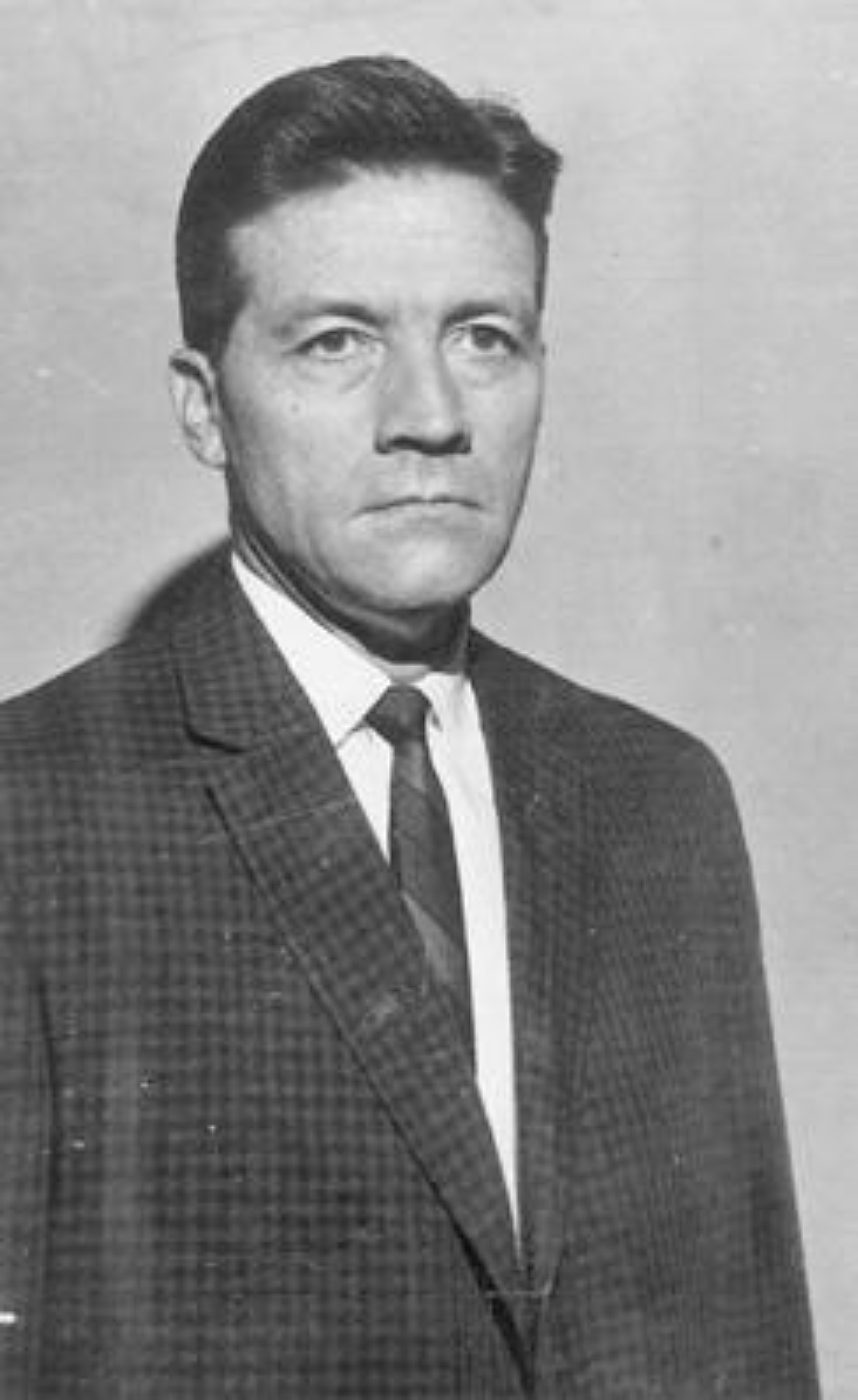
The Personal Library of Colonel
479 books across four branches of thought — the shelf that built the OODA loop.
The Man & The Mind
John Boyd, fighter pilot and military strategist, 1927–1997
Colonel John Richard Boyd never published a book. His legacy lives in a briefing — A Discourse on Winning and Losing — and in the minds of the officers, defense officials, and strategists he still influences today.
Boyd read voraciously. His personal library spanned military history and thermodynamics, Zen philosophy and cybernetics, chaos theory and Toyota production systems. These books were not decoration — they were raw material. Each one contributed a concept, a metaphor, or a formal tool to the OODA loop.
This project maps that library: 479 verified books from Boyd's collection. Hover any title in the rankings to read a description. Below, we also speculate about what Boyd would have read had he lived past 1997.
The Full Library
Books drawn from Boyd's personal papers — ratings from Goodreads. Sort by rating, year, title, or category. Filter by branch. Pin favorites. Hover any title for a description. Click a title to find copies.
Taxonomy
Boyd's library organized into four intellectual branches. Click a branch or category to filter the rankings above.
Click nodes to expand · Click category to filter rankings
Data Analysis
403 titles plotted by esteem and reach. Boyd's shelf skews scholarly and admired — the mass piles up between 4.0 and 4.4, the register of respected nonfiction. Hover any point or bar for details.
Every book sits at the crossing of two questions: How good? (average rating, left to right) and How read? (number of ratings, log scale, bottom to top). The plane divides into four temperaments.
Vertical: number of ratings (log₁₀). Horizontal: average rating. Dashed crosshairs mark the median count and a 4.0 rating. Dot size encodes reach.
A handful of titles in Boyd's library escaped into mass readership — hundreds of thousands of ratings apiece. Reach and regard rarely move together.
Top 14 titles by number of ratings. Bar length = reach (log₁₀). Trailing figure = average rating.
Strip away popularity and ask only: how are these books rated? Boyd's shelf skews scholarly and admired — the mass piles up between 4.0 and 4.4.
Distribution of average ratings across all 403 titles. Curve = kernel density; ticks below = individual books.
For 106 titles the catalogue records two scores: the highest recorded rating (often a small devoted edition) and the most-rated edition. 73 slope downward — enthusiasm cools as readership widens.
Each line = one book. Left: highest recorded rating. Right: most-rated edition rating. Hover any line.
John Boyd died on March 9, 1997. He was 70 years old. What follows is speculation: books published after his death that extend the intellectual traditions he built. These are not books Boyd read. They are books Boyd might have read.
Post-1997 Projections
Each speculative title is rated 4.0 or above on Goodreads and connected to a specific book in Boyd's actual library.
Speculative attribution is inherently contested. Boyd was an idiosyncratic reader who followed intellectual scent wherever it led. These selections represent a reasoned reconstruction based on his documented interests and intellectual communities. Treat this section as a reading list inspired by Boyd, not a prediction.
About This Project
A speculative book is one that (a) Boyd could not have read because it was published after March 9, 1997; (b) belongs to an intellectual tradition Boyd demonstrably engaged with; and (c) has a Goodreads rating of 4.0 or above. Speculative attribution does not imply endorsement.
Goodreads ratings systematically favor popular, contemporary, and narrative-driven books. Dense academic texts are underrated relative to their intellectual significance. The ratings here are useful for ordering but should not be mistaken for quality rankings among technical texts.
Boyd's reading was not algorithmic — it was driven by personal recommendation and the intellectual network of the Pentagon reform movement. The speculative selection uses topic modeling as a starting point, but final choices reflect editorial judgment. No algorithm can fully replicate a mind like Boyd's.
Each speculative book includes a connection edge to a specific book in Boyd's actual library. Curated edges prioritize intellectual lineage over superficial topic similarity.